Smarter Than
Your Toaster
AI doesn’t just answer your questions. It shapes what you do next.
If work feels less certain lately, you’re not imagining it.
If you guide others, the stakes are higher.
Takes less than 30 seconds.
You might see something you didn’t expect.
YOUR answers determine what you see next.
What’s actually changing.
AI is not replacing your thinking.
It is shaping it — quietly, consistently, and often invisibly.
If you accept the first answer, you inherit the pattern.
If you question the frame, you begin to see it.
This is not about intelligence.
It is about awareness.
See the difference in 30 seconds.
One question can close the door. A better question can open the room.
From The AI Book For All: “A good question does more than fetch an answer.”
You are not trying to sound clever. You are learning how to direct the tool before it quietly directs you.
1. The closed prompt
A closed prompt gives the machine too little room to help you think. It usually produces a generic answer because the frame is too narrow.
Prompt
How can I use AI at work?
You will probably get a list. Useful, maybe. But not personal enough to change your next move.
2. The open prompt
An open prompt gives the machine a better job. It asks for possibilities, trade-offs and perspective instead of a quick answer.
Prompt
Give me three ways AI could replace parts of my role, and three ways I could adapt to stay relevant.
Now the answer has to do more than reassure you. It has to show pressure points and possible responses.
3. The boundary prompt
Boundaries sharpen the result. They tell AI what kind of answer is useful, humane and usable right now.
Prompt
Explain this as if I am overwhelmed, not unintelligent. Give me one practical step I can take in the next 24 hours.
That small boundary changes the tone. It moves the response from information dump to usable guidance.
The 5WH Lens
Use these six small doors when the answer feels too easy.
Try it now.
Take a question you were about to ask AI. Before you submit it, add one sentence:
That is the shift. You are not asking AI to decide for you. You are asking it to widen the field so your judgment has more room to work.
R. K. Antonio
Author — The AI Book For All
Background in healthcare, systems & AI literacy
Want to see how this works in a classroom?
See the classroom application →The moment this clicks.
From The AI Book For All · Chapter 7
You thought AI was answering your question.
It was answering a version of your question shaped by everything it had seen before.
The moment you change the question,
you change the path.
The question is whether you are the one using it — or whether it is quietly using you.
For Educators & Leaders
If you guide others—students, teams, or a classroom—this applies differently.
AI is not a subject to be taught. It is an environment students must learn to navigate.
The moment this clicks.
From The AI Book For All · Chapter 7
You thought AI was answering your question.
It was answering a version of your question shaped by everything it had seen before.
The moment you change the question,
you change the path.
The question is whether you are the one using it — or whether it is quietly using you.
For Educators & Leaders
If you guide others—students, teams, or a classroom—this applies differently.
AI is not a subject to be taught. It is an environment students must learn to navigate.
AI literacy is not optional
for those who guide others.
If you are responsible for what others learn—this moment matters more than it does for anyone else in the room.
AI is not a subject to be taught—it is an environment students must learn to navigate.
Students don’t need more answers—they need better filters.
AI doesn’t replace thinking—it exposes weak thinking.
Literacy now includes evaluating machine-generated information.
The Offer
If you’re responsible for guiding others—this matters more.
Your students are already using AI. The question is not whether to address it—it is whether you are equipped to help them use it critically rather than passively.
AI Literacy Implementation Snapshot
A short, structured PDF including:
• 3-week classroom pilot model
• Sample activities and prompts
• Measurement rubric for student thinking
• Research grounding (UNESCO, OECD, learning science)
Free PDF · No email required
Want updates when new educator resources are available?
Leave your email below ↓ This is not a theoretical model.
It is a structured, testable classroom pilot.
Designed to be reviewed in under 5 minutes.
What this pilot includes
A 3-week structure (awareness → evaluation → guided use), student activities, and simple teacher prompts.
What it measures
Student ability to question AI output, improvement in prompt quality, and awareness of bias and assumptions.
What it does not require
No new curriculum. No technical expertise. No additional tools.
Trusted Source
R. K. Antonio
Author of The AI Book For All
Systems thinker • Healthcare background • AI literacy educator
Author of the AI literacy framework used in this pilot
Designed specifically for educators, leaders, and decision-makers
The book is the starting point.
The pilot is how it becomes practice.
Get the AI Literacy Implementation Snapshot
Enter your email and we’ll send the 5-minute pilot framework directly to you.
Your snapshot is ready.
No sign-in required. Opens directly in your browser.
Open the PDF ↓If you’re exploring how this could work in your classroom or organization, you can walk through it with me.
Schedule a clarity session →About this project
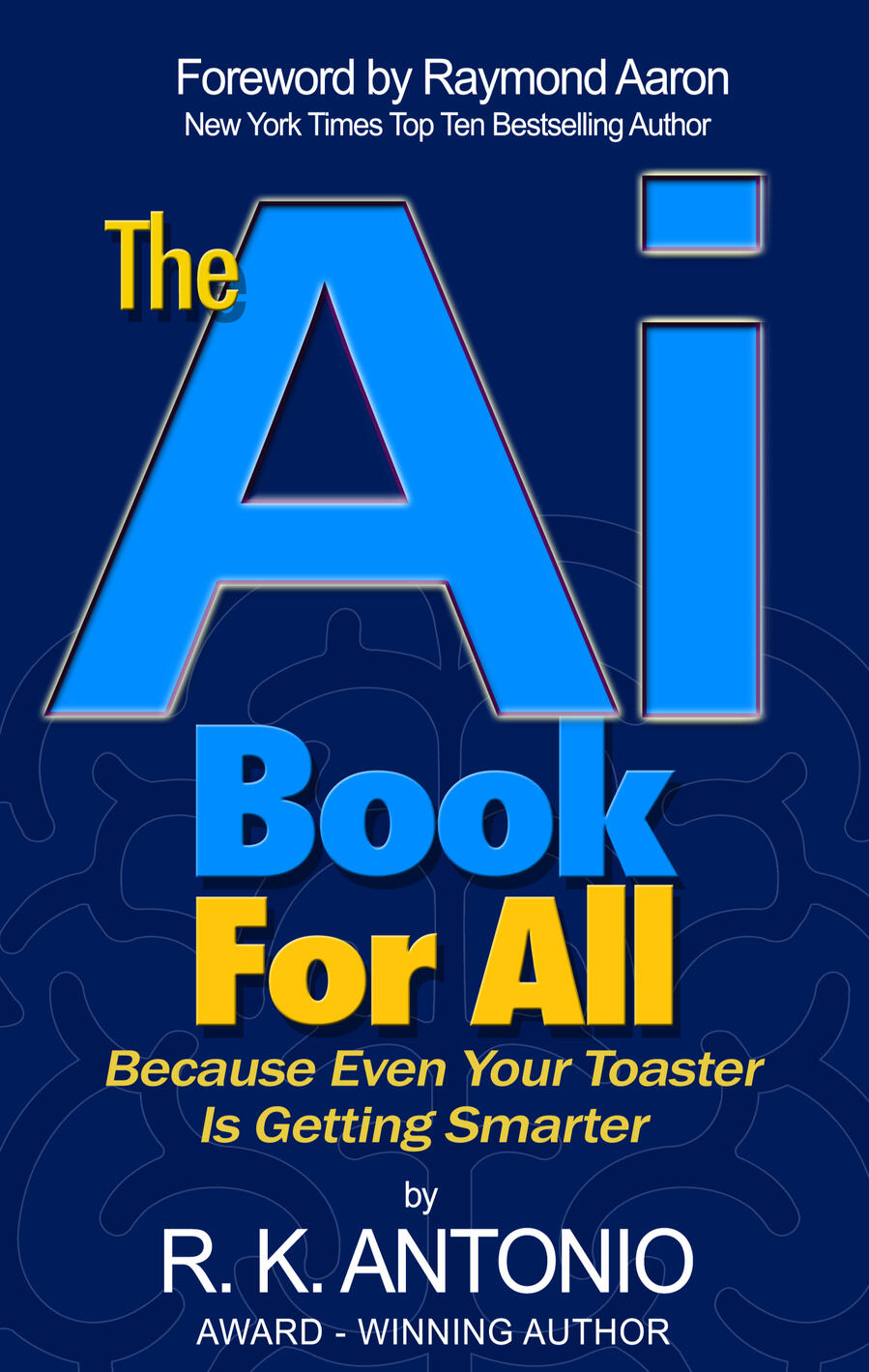
Smarter Than Your Toaster is the official AI literacy initiative of RK Antonio and Antonio’s Magnet, created to help everyday people understand artificial intelligence without hype, fear, or jargon. It supports the broader work of The AI Book For All: Because Even Your Toaster Is Getting Smarter.
Think with AI.
Keep your clarity. Keep your agency. Keep your voice.
Thank you for supporting this work — every purchase helps amplify ethical, human-centered AI literacy.
Smarter Than Your Toaster™ Project
Made for a world that’s finally growing up.
A nonprofit initiative currently in development (not yet registered). No donations are currently being solicited.
© 2025 Antonio's Magnet, LLC.
All Rights Reserved.